Underpayment review
We compare each payment against your contracted fee schedule and flag shortfalls for reprocessing.

Unpaid insurance claims rarely fix themselves. Our AR team works every open claim on a fixed cadence, escalates before deadlines, and shows you exactly where every dollar stands.
 Photo: RDNE Stock project / Pexels
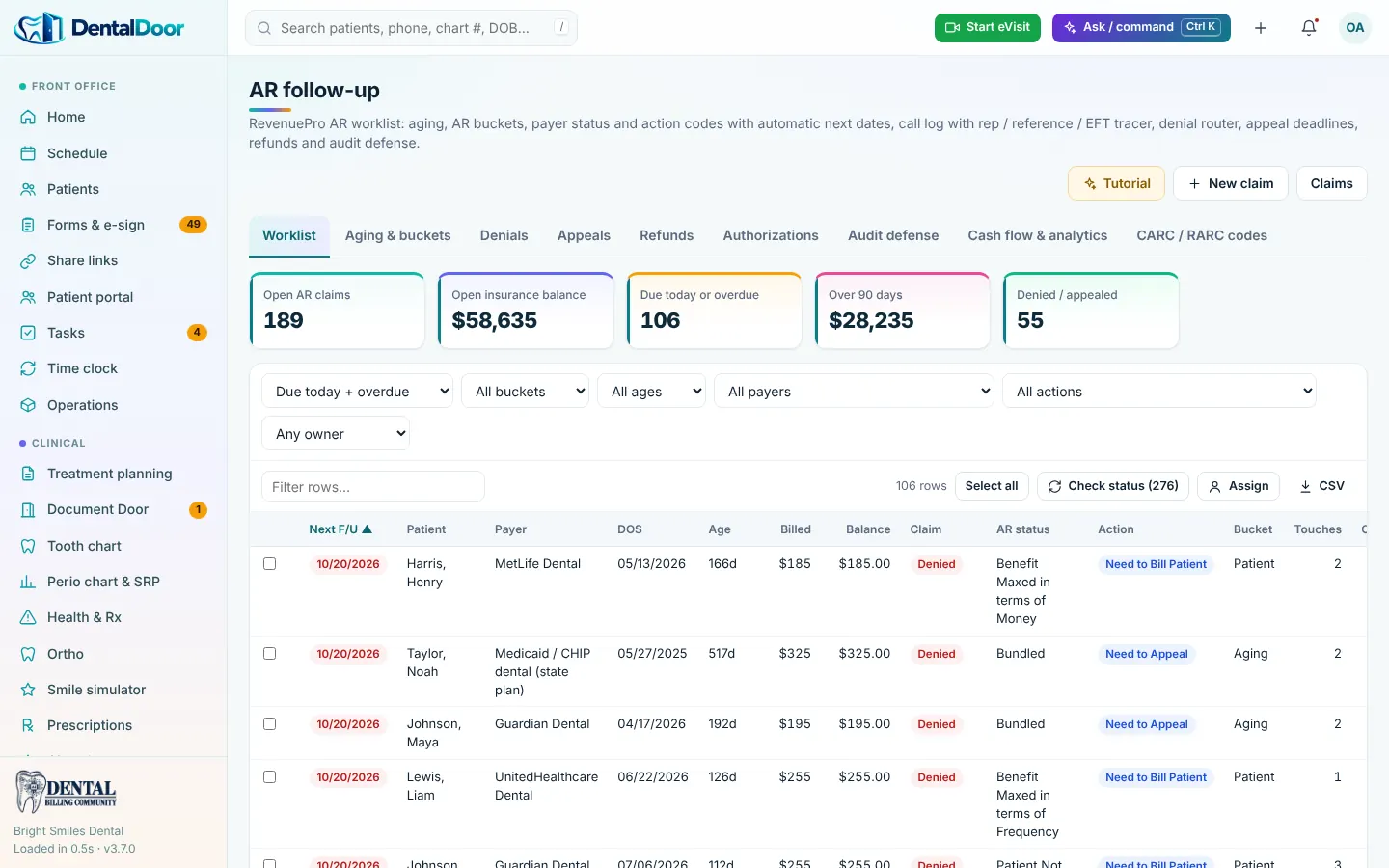
Insurance AR grows when claims go out and nobody follows them: claims lost between clearinghouse and payer, requests for information sitting in a portal inbox, underpayments posted without question, and appeals filed after the deadline.
The fix is not heroics — it is a cadence. Every open claim gets a next action and a date, and older buckets get worked first.
| Bucket | What it means | Our action |
|---|---|---|
| 0–30 days | Normal processing window | Confirm payer receipt; resolve clearinghouse rejections the same day |
| 31–60 days | Possible missing info or pend | Status check via portal/277 response; supply attachments or narratives requested |
| 61–90 days | Something is wrong | Call the payer, document the reference number, correct and resubmit or start a reconsideration |
| 90+ days | High risk of loss | Escalate, appeal with documentation, or recommend write-off with an audit note — never silently |
 Photo: Yan Krukau / Pexels
We compare each payment against your contracted fee schedule and flag shortfalls for reprocessing.
Alternate-benefit downgrades are appealed when documentation supports the procedure performed.
Timely-filing and appeal windows are tracked per payer so nothing ages out by accident.
Level 1 and Level 2 appeals with narrative, X-rays, charting and the plan language that supports payment.
Recurring denial reasons feed back to front-desk and coding fixes so the same denial stops coming back.
Aging, collections and denial trends — plus the AR dashboard available on this site.
Yes. We usually start with a one-time aged-AR project, prioritizing high-value claims that are still within appeal or timely-filing windows.
Yes — see Patient Statements & Collections. Insurance AR and patient AR are reported separately so you can see both clearly.
Every follow-up is noted on the claim in your PMS with date, payer reference number and next action, and summarized in a monthly report.
Six reasons practices across the US hand us their revenue cycle.
Our team works only in dental revenue cycle — CDT, dental plans, Medicaid dental and the payers your practice actually bills.
We bill the medical plan when it should pay — oral surgery, trauma, biopsies, TMD and oral appliance therapy — with compliant cross-coding.
Automation speeds verification, scrubbing and follow-up; experienced billers review every exception.
Monthly KPI reviews plus live verification and AR dashboards. You always see where every claim stands.
BAA with every client, named logins, MFA where supported and minimum-necessary access.
Verification, coding, claims, AR, denials, posting, patient billing and credentialing — no hand-offs between vendors.

Thirty minutes on a screen share. A written action plan afterward. No obligation.
Coding changes, payer alerts and new case studies — straight to your inbox.
Join the communityEducational content only — not legal, coding-certification or payer-specific advice. Code sets (CDT, CPT, ICD-10-CM, HCPCS) and payer policies change; always confirm against the current code manual and the patient's plan. CDT is © American Dental Association. CPT is © American Medical Association.