Request Call With Me

Edit Template
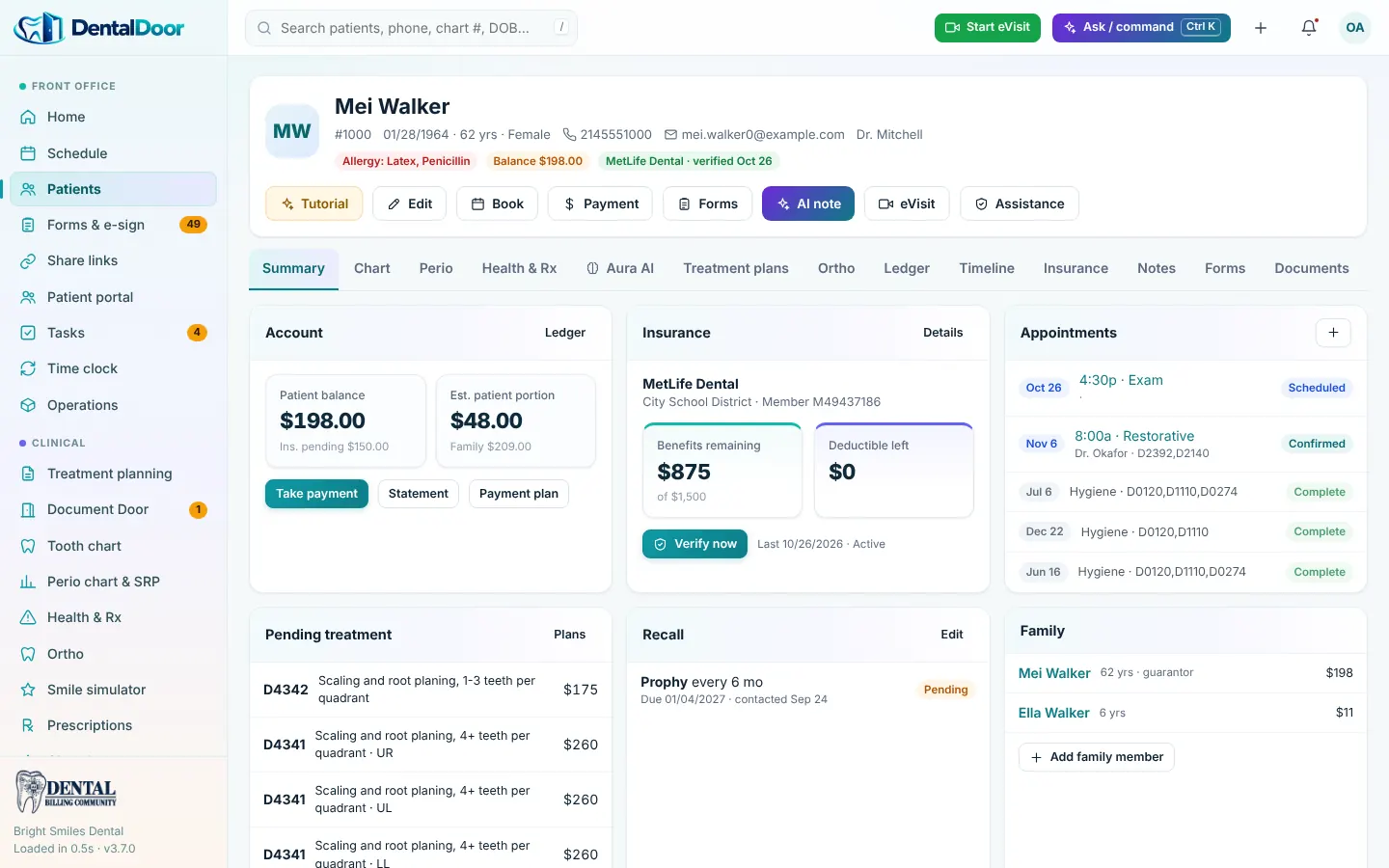
Patient Balance Management & Collections Revenue Recovery
Patient Balance & Collections Mastery

The $200,000-$800,000 Revenue Recovery Opportunity

Patient balance management and collections represents the final critical step in revenue cycle—yet 80-90% of dental practices lack systematic processes, losing $200,000-$800,000+ annually. Transform inaccurate balances, uncollected payments, and poor practices into systematic revenue recovery through AI-powered automation and professional collection strategies.

80-90%
Practices Lack Systematic Processes
30-40%
Patient Balances Uncollected
$200K–$800K
Annual Revenue Lost
50% to 85%+
Improvement Potential

Understanding Patient Balance Components

Accurate patient balance calculation requires understanding five key components that combine to determine total patient responsibility. Each component plays a distinct role in determining final patient financial responsibility.

Copay

Fixed amount per visit/service ($25-$150). Office visits ($25-$50), preventive ($0-$25), basic ($25-$75), major ($50-$150).

Deductible

Annual pre-insurance amount ($50-$300). Resets January 1. Applies to basic/major but typically not preventive.

Coinsurance

Patient percentage post-deductible. Preventive 0%, basic 20%, major 50%. Varies by plan and service.

Non-Covered Services

Insurance excluded services (100% patient responsibility). Cosmetic, premium materials, certain implants.

Insurance Write-Off

Contractual difference between billed and allowed. Cannot bill patient for this adjustment.

Annual Maximum

Maximum insurance pays yearly ($1,000-$2,500). Patient pays 100% once maximum reached.

Calculation Accuracy Impact: 20-30% of patient balances are calculated incorrectly. Each error creates billing disputes, payment delays, and patient dissatisfaction. Inaccurate copay calculations of $25-$150 per procedure compound quickly across hundreds of annual patients, resulting in $50,000-$300,000 annual revenue loss from calculation mistakes alone.

Copay & Deductible Application Mastery

Deductible Application Process

Accurate deductible application prevents underbilling and ensures complete revenue capture throughout the year.

1
Identify Deductible
Plan deductible amount from insurance verification
2
Track Applied
Document deductible used to date during year
3
Calculate Remaining
Determine balance still available for current service
4
Apply To Current
Apply remaining deductible if service applicable
5
Recalculate Balance
Compute patient responsibility with deductible applied
6
Document Usage
Record all deductible tracking for audit trail

Coinsurance Calculation Framework

Preventive Services

  • Coinsurance: 0% (100% covered)
  • Examples: Cleanings, exams, radiographs
  • Patient copay only, no coinsurance
  • Deductible typically not applied

Service Level Impact

  • Basic: 20% coinsurance (80% covered)
  • Major: 50% coinsurance (50% covered)
  • Annual max applies after deductible
  • Accuracy critical for each category

Insurance Verification & Patient Estimates

Pre-Treatment Insurance Verification Process

Verifying insurance before treatment is foundational to accurate balance calculation and estimate generation.

Contact Insurance
Call insurance or use online verification portal
Verify Coverage
Confirm patient active and policy current
Confirm Details
Verify copay, deductible, coinsurance, maximum
Document Everything
Record all details for patient file reference

Patient Estimate Generation Framework

Billed Amount

Practice standard fee for planned service

Insurance Allowed

Contractual amount insurance pays

Insurance Payment

Estimated insurance portion based on benefits

Patient Responsibility

Estimated patient portion including all components

Estimate Qualifications: Always include disclaimers: "Based on current plan information," "Final balance determined when insurance processes claim," "Assumes deductible [amount] met/not met," "Subject to plan limitations," "May vary from final billing." Clear qualifications prevent disputes and manage expectations.

Strategic Collection Framework

Payment Collection Points: Optimal Timing

1
At Check-In
Collect known balances on arrival
2
Before Treatment
Most effective for large estimated balances
3
At Checkout
Common for copays and known balances
4
After Insurance
Collect remaining once determined

Multiple Payment Methods Boost Collection

Credit/Debit Card
Most common with immediate processing
ACH Bank Transfer
Lower fees, ideal for payment plans
Cash Payment
No processing fees, preferred by some
Check Payment
Traditional method, familiar to patients

Systematic Collection Follow-Up Process

Timeline Steps

  • Day 1: First professional statement
  • Day 30: Reminder with urgent tone
  • Day 45-60: Personal phone call
  • Day 75: Final notice warning
  • Day 90+: Collections agency referral

Collection Call Technique

  • Verify patient identity first
  • State call purpose professionally
  • Explain balance and due date
  • Request payment method preference
  • Listen to patient concerns
  • Offer payment solutions

Payment Plans & Financial Arrangements

Payment Plan Setup Framework

Payment plans appropriate for balances $500-$1,000+ with monthly installments over 3-12 months. Formal written agreement required. Automatic payment setup dramatically improves compliance.

1
Discuss Options
After estimate provided with patient
2
Determine Terms
Plan length and monthly payment amount
3
Create Agreement
Written contract with all terms specified
4
Set Automatic Payment
Automatic payment when possible
5
Document & Monitor
Record terms, follow-up on payments
Payment Plan Impact: Systematic payment plans collect 80-90% of large balances that might otherwise remain unpaid. For practices with 50-100 payment plan patients annually, this represents $100,000-$400,000 in recovered revenue that would otherwise be written off.

Bad Debt Determination & Write-Off Process

Collectible vs. Uncollectible Determination

Collectible Characteristics

  • Patient responds to contact attempts
  • Patient made partial payments
  • Patient requested arrangements
  • Good payment history existing
  • Stable financial circumstances
  • Balance under 6 months old

Uncollectible Characteristics

  • Ignores all contact attempts
  • Collection agency unsuccessful
  • Pattern of non-payment shown
  • Patient cannot be located
  • Significant aging (6+ months)
  • Collection cost exceeds balance

Financial Hardship Consideration

Compassionate approach recognizes genuine patient hardship while maintaining business needs. Proper documentation supports hardship write-offs while preventing abuse.

Job Loss
Documented unemployment or income loss
Medical Emergency
Serious health crisis with documented expenses
Family Crisis
Death or serious family illness situation
Documented Constraints
Verified low income or bankruptcy

Bad Debt Write-Off Recording

1
Calculate Amount
Exact balance being written off
2
Document Efforts
Collection attempt evidence compiled
3
Get Approval
Owner/manager authorization required
4
Record as Expense
Bad debt expense in accounting system
5
Remove from A/R
Clear from aging reports
6
File Documentation
Maintain records for audit

AI-Powered Patient Balance Revolution

Advanced AI systems eliminate manual calculations, automate collections, manage payment plans, and predict uncollectible balances—achieving 100% calculation accuracy while freeing staff for patient care.

Core AI Systems

AI ENGINE

PatientBalanceCalculator AI™

Automatic balance computation with 100% precision. Analyzes insurance, applies copay/deductible/coinsurance, generates accurate estimates. Cost: $2,500-$3,500/month. Benefit: $150K-$500K annually. ROI: 4,300%-20,000%.

AI ENGINE

CollectionsAutomation AI™

Tracks balances, sends smart reminders, makes collection calls, escalates strategically. Never misses follow-up. Cost: $2,200-$3,000/month. Benefit: $120K-$450K annually. ROI: 4,000%-20,000%.

AI ENGINE

PaymentPlanAutomation AI™

Automates setup, tracks compliance, monitors defaults, sends reminders, handles escalation. Cost: $2,000-$2,800/month. Benefit: $100K-$400K annually. ROI: 3,500%-20,000%.

AI ENGINE

BadDebtPredictor AI™

Identifies uncollectible balances early. Machine learning analysis. Recommends write-offs with confidence. Cost: $1,800-$2,500/month. Benefit: $80K-$300K annually. ROI: 3,200%-16,700%.

INTEGRATED

IntegratedPatientBalanceRecovery™

Complete platform integrating all four AI tools. Full lifecycle automation from calculation through write-off. Cost: $6,000-$8,500/month. Benefit: $800K-$2M+ annually. ROI: 9,600%-40,000%.

AI Performance Metrics: 100% calculation accuracy vs. 70% manual baseline. 95%+ staff time reduction. $400,000 maximum annual value prevented. 2-second per procedure processing speed. Never missed follow-up or collection opportunity.

Patient Balance Recovery Implementation Packages

Small Practice
$1.8K–$2.5K

Per Month

  • Balance calculation support
  • Patient estimate generation
  • Collection basics training
  • Bad debt determination guidance
  • Monthly reporting
$150K-$400K annual value | 6,000%-26,000% ROI
Medium Practice
$3.5K–$5K

Per Month

  • All small services PLUS
  • CollectionsAutomation AI™
  • PaymentPlanAutomation AI™
  • Advanced dashboards
  • Dedicated support specialist
$300K-$800K annual value | 7,000%-27,000% ROI
Enterprise
$6K–$8.5K

Per Month

  • All medium services PLUS
  • IntegratedPatientBalanceRecovery™
  • 6-8 specialist team
  • 24/7 real-time monitoring
  • Executive dashboards
$800K-$2M+ annual value | 9,600%-40,000% ROI
Comprehensive Financial Impact:
Small: $150K-$400K recovery | 6,000%-26,000% ROI
Medium: $300K-$800K recovery | 7,000%-27,000% ROI
Enterprise: $800K-$2M+ recovery | 9,600%-40,000% ROI

Five Strategic Value Propositions

Safety & Compliance
Fair debt practices. Proper documentation. Tax compliance. Risk mitigation.
Financial Growth
$200K-$800K+ annual recovery. 50%-85% improvement. 300%-600%+ ROI.
Patient Satisfaction
Accurate calculations. Clear communication. Transparency. Professional approach.
Operational Efficiency
95%+ automation. 80-90% staff time savings. Scalable infrastructure.
Competitive Advantage
AI-powered mastery. Industry leadership. Advanced analytics. Market differentiation.

Ready to Recover Your $200,000-$800,000?

Every month of delay costs $15,000-$70,000+ in unreovered patient balances. Get your complimentary patient balance audit today.

Schedule Free Assessment